on Tripadvisor


Khaudum National Park is located in north-eastern Namibia. It lies in the middle of the northern Kalahari and is one of the wildest corners of the country. While adventure is calling on the one hand, the difficult access conditions are a deterrent on the other. You can find out more about whether Khaudum National Park is worth a visit in today’s blog.
Khaudum National Park – the harmless version
The Khaudum National Park is a good 3842 km2 in size but has hardly been developed for tourism. The area around the park is sparsely populated. To the west and north of it live predominantly Kavango peoples, who mainly belong to the Gciriku tribe. South of the national park are mainly Ju/’hoansi-San. They live in the Nyae-Nyae Conservancy. In this conservancy they have the right to use their natural resources sustainably (!) and to capitalize on them economically.
The wildlife of Khaudum National Park constitutes one such natural resource. Since there is only one fence on the Botswana border, they are free to roam the national park and the fence-free areas around it, including the Ju/’hoansi-San conservancy. Together, Khaudum National Park and its surrounding protected zones increase the wilderness area to more than 11,000 km².
This constellation of national park and surrounding conservancies enables travelers to encounter wildlife as well as have cultural experiences with the locals. But Khaudum is in the northern Kalahari sand field, which doesn’t make access to the national park easy. Therefore, the question “Is it worth visiting Khaudum National Park?” is justified. Today’s blog will try to help you answer this question.

The Khaudum National Park – a challenge for adventurers
No other national park in Namibia presents adventurous challenges as the Khaudum National Park does. The approximately 300 km long road network takes you along meandering sandy paths through untouched bush and dry acacia forests. It goes through dry river valleys, the Omiramba (singular: Omuramba), which run parallel to the orange-red, east-west oriented Kalahari longitudinal dunes. Signage? Barely! Navigation is based either on your own sense of direction or on GPS coordinates and topographical maps. The result: only a few visitors.
Would you like to know more about travelling in Namibia?
Just get in touch with us!
Is that all? No! Nothing works here without four-wheel drive. Thick, soft sandy fields are the only slopes you can ski here. If you stop in the wrong place or have to stop because an elephant is in the way, you need to know how to get the car moving again. Breakdown or towing services? Hahaha! Unless you have a satellite phone with you. Regular phones have no signal in most areas of the national park. And other vehicles pass by less often than shooting stars in the night sky.

It is the appeal of good preparation that creates the special thrill. In other words: to be on the road with at least two cars, to have enough filled spare petrol or diesel canisters with you and to have enough provisions and even more water. The answer to the question “Is Khaudum National Park worth a visit?” depends on whether or not you have a thirst for adventure.
Vegetation and landscapes
In addition to the seclusion, the landscape in Khaudum National Park is also impressive. The Kalahari is not just a sandy desert. Along the rivers, sand mixes with grass. Termite mounds soar and camelthorn trees tower over the plains. Mixed forests of bushes and trees appear between the dunes. Zambezi teak alternates with sandseringe and mukwa. Mighty baobab trees enrich the view. In the savannas, wild seringa, and false mopane trees crowd into sight.
You might not initially expect such a wealth of species when entering the national park. It suggests more than desert-like aridity. Precipitation from September to April, but especially from the end of December to the beginning of March, brings an amount of rain that increases from the south-west to the north-east and averages 430 to 550 mm/year. Enough to bring lush vegetation to the landscape. It is not only something for the eyes of the visitors, but also food and protection for the animals.
We offer tailor-made tours to Khaudum National Park:
Tailor-Made Tours
on request
Which animals can you see here?
With the size of the national park and at the same time few roads, it can sometimes be difficult to spot animals in Khaudum National Park. But they are there, and depending on the season there are plenty of them. In the dry season, the park quickly overflows with roaming elephants. They gorge themselves on vegetation and dig boreholes in the peaty soils of shallowly dried rivers, where they find water to drink. However, artificial water points also prevent dehydration. The latter can all be reached via the drivable tracks.

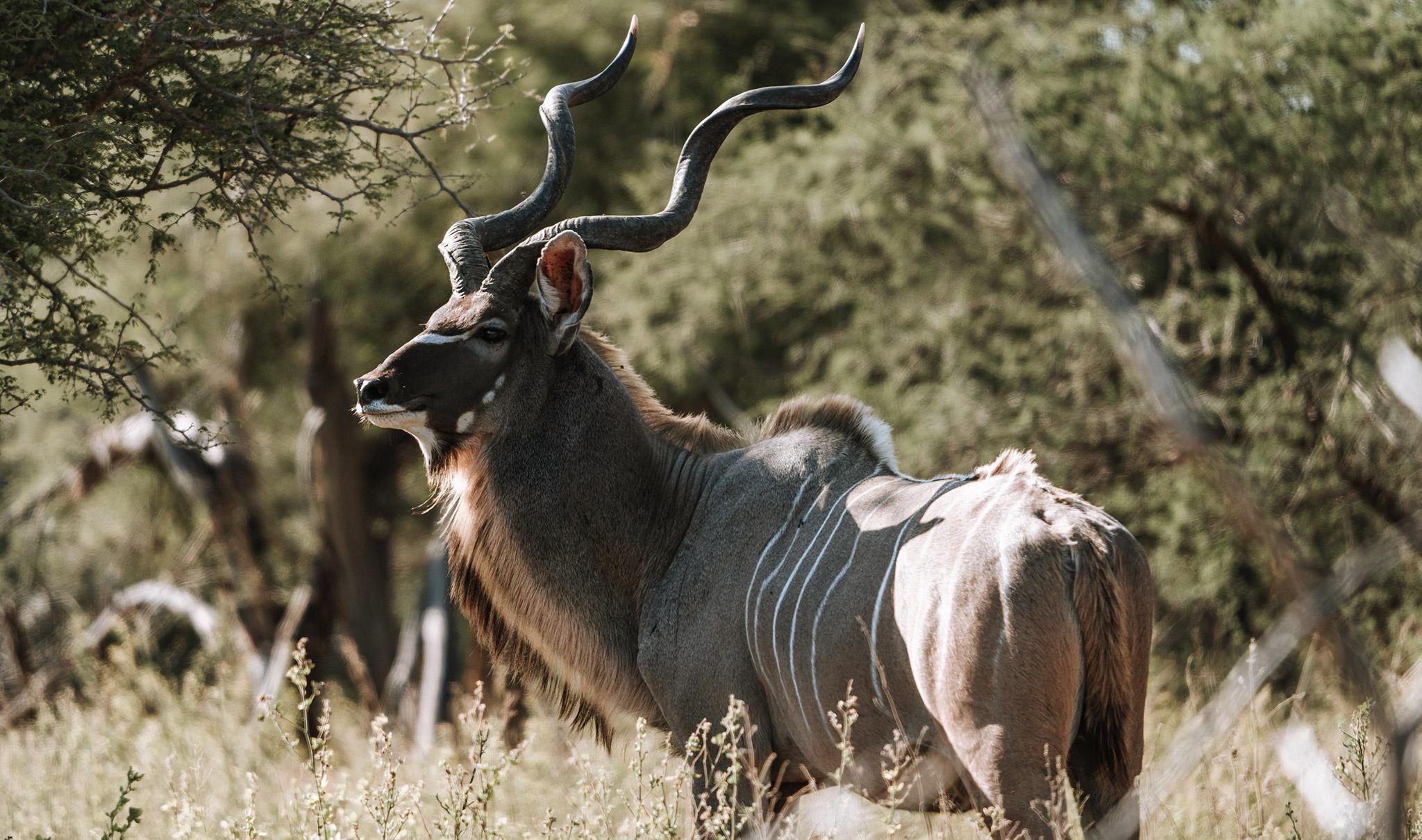
Year-round residents include giraffe, eland, wildebeest, hartebeest, kudu, gemsbok, steenbock, duiker, bat-eared fox, hyena, lion, leopard, jackal, warthog, vervet monkey, ostrich, and anteater. Rare and difficult to spot elsewhere in Namibia, roan antelope and tsesebees can also be found in Khaudum. They are more common in the northern part of the park than in the southern. Another special feature are the African wild dogs, which are increasingly threatened with extinction. But you need a bit more luck to see them.
In the African summer, when it is the rainy season, you can also observe birds very well in the national park. These include birds such as flamingos, cranes, herons, ducks, and geese. In particular, the pan field of the Nyae Nyae Conservation Area south of the national park then blossoms into a true paradise for bird watchers. A visit to Khaudum National Park is definitely worthwhile for a view of the wildlife.

Accommodation options in Khaudum National Park
Due to its location and conditions, Khaudum National Park is by no means as touristy as other sights in Namibia. It is well off the typical tourist trail. Little will be changed in the tourist infrastructure in the park. It should deliberately remain wild. There is good accommodation in the north (Khaudum Camp) and in the south (Sikereti Camp). Mostly there are pitches for tents. But there are also a few luxurious tents there now.

Travelers who come here are also usually very interested in the Ju/’hoansi-San Living Museum, which is now well-known throughout the country. There is also a campsite here. In the evening, you can listen to the stories of the San about their belief and mythology while sitting around the campfire. Or they show you their traditional dances. In the morning you go on a bushwalk with them, where they teach you about traditional life and knowledge as hunters and gatherers. A visit to the Khaudom National Park and its surroundings can also be worthwhile for this.
The best time to visit Khaudum National Park
You can travel here all year round. However, during the rainy season, the climate is hot and humid, especially between January and March. The average temperature during this time is 33°C. Which means it can get a lot hotter than that even. In the domestic winter months, on the other hand, it is drier and cooler. Nevertheless, there are still many warm hours of sunshine. The average maximum temperature during this time is 26° C, the minimum temperature at night is 7° C. Here, as elsewhere in Namibia, the dry season from May to September/October is particularly good for animal observations in the Khaudum National Park.
Conclusion
For the adventurous and 4×4 fans, a visit to Khaudum National Park is worthwhile simply because of the challenging conditions. If you are looking for a more comfortable safari, you will not be happy here. What makes Khaudum National Park special are the following things:
- Seclusion
- Deep, soft sand tracks that require 4×4 vehicles
- Few roads in a relatively large area, making wildlife viewing difficult
- Few visitors
- Minimal tourist infrastructure
- Avoidance of fences as far as possible, which gives you the feeling that the animals can really move freely
- Large numbers of elephants in the dry season
- Possible visit to the living museum of the Ju/’hoansi-San
Those who would like to venture into the Khaudum adventure may still have questions or need help planning their Namibia trip. We are happy to do this – whether on a tailor-made guided tour or a self-drive tour. As a local company, we are always well informed about the current situation. So, get in touch with us!
Author: Juan Proll