 on Tripadvisor


You can find Africa’s largest canyon – the Fish River Canyon – in southern Namibia. It took evolution millions of years to create it. As it is situated slightly off the beaten track, travellers find themselves wondering: is the Fish River Canyon worth a visit? Today’s blog will tell you more!
The myth of the giant snake
The Fish River winds its way through the gorge, which is up to 27 kilometres wide and 650 metres deep, over a distance of about 160 kilometres. According to Nama mythology, the Fish River Canyon was created by a giant snake. After all, the Namas inhabited this area long before European missionaries and colonialists arrived. At that time, the Namas were less hunter-gatherers than descendants of the San. They were more sedentary and knew agriculture and animal husbandry. But according to their legend, a giant snake also lived here, feeding on the Namas’ sheep and goats. They felt their existence was threatened.
To ensure their survival, these people saw only one solution to their problem: the monstrous snake had to die. – So they took up their spears, arrows and bows, set their dogs to work, lighted torches and attacked the giant serpent from all sides with men and mice. The Namas used torches to keep it at bay. An arsenal of arrows pierced it skin. And with supernatural strength, the brave humans rammed the spears into the giant’s muscular body. Soon, the monstrous reptile was suffering. Without a chance, it rolled back and forth in its death throes, tearing visible trenches in the stony ground, deeper and deeper, wider and wider. Finally, the giant snake collapsed lifeless in its self-dug grave, and the Fish River Canyon was born. From then on, people lived peacefully and happily … and so the story continues.
If you look down the canyon today, you will see no trace of this prehistoric battle. But imagination is present. As I gazed upon this massive canyon for the first time, I was in awe of another of nature’s wondrous creations.

Is the Fish River Canyon worth a visit? Fun for geology lovers
Whether the giant snake is myth or reality, there are also geological theories about the history of the Fish River Canyon. Here, instead of the giant snake, it is the water that mustered enormous strength to burrow into the earth’s strata. However, as the water soon encounters hard layers of quartzite, it begins to flow out more in the width rather than making its way into the depths. Only the very slow process of the break-up of the giant continent of Gondwana about 150 million years ago changed this. As the modern continents of South America and Oceania separated from Africa at that time, land uplift occurred. This caused the Fish River to fall more steeply, giving it a higher flow velocity. This gives the river more power to break through the resistance of the hard rock and carve its way into deeper layers.
Would you like to know more about travelling in Namibia?
Just get in touch with us!
Namibia’s extremely dry climate in much of the desert country leaves bare rock formations with little to no vegetation. The different layers can be seen as clearly as the annual rings on a freshly felled tree trunk. The country is a dream come true for (amateur) geologists who enjoy understanding the unique history of its formation by looking at the rocks. For them, a visit to the Fish River Canyon is definitely worth it.

Canyon with a view
There are a number of viewpoints along the rim. From here you can see very clearly how a canyon has been created in the canyon during the different stages of its formation. A fascinating sight. Unfortunately, there is very little water left in the canyon, as the river has been dammed in two places on its long way to the canyon. At least the coloured rock layers on the canyon walls are still visible. Especially in the morning sun, they can be seen at their best from the Hoba viewpoint (East side).
The Fish River Canyon is also well worth a visit for those who simply want to enjoy the panoramic views. Sunrises and sunsets provide many romantic moments. Shimmering green riverbeds in the depths invite you to come closer. And then there is the dimension of the gorge. It’s what magically draws you in and makes you reluctant to move on. Instead, you want to stay, gaze into the distance, breathe in the silence and, preferably, fly like a drone into the canyon.
For a longer stay, visit the Fish River Lodge on the West side of the canyon – accommodation for true connoisseurs. The spacious and tastefully decorated cabins are close enough to the edge of the canyon for relaxing moments with panoramic views from the veranda. Here, a visit to the Fish River Canyon is definitely worth it.
Our favourite tours visiting the Fish River Canyon:
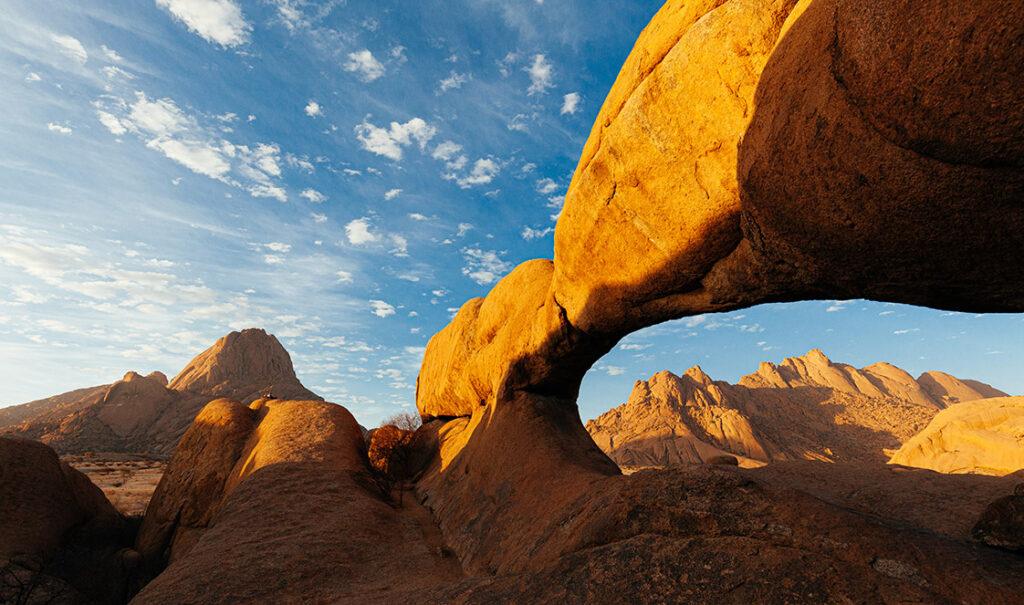
Magnificent Namibia
Places Windhoek, Kalahari, Keetmanshoop, Fish River Canyon, Luderitz, Namib Desert, Swakopmund, Erongo Mountains, Damaraland, Etosha National Park, Waterberg Plateau
from getting current exchange rate… per person sharing
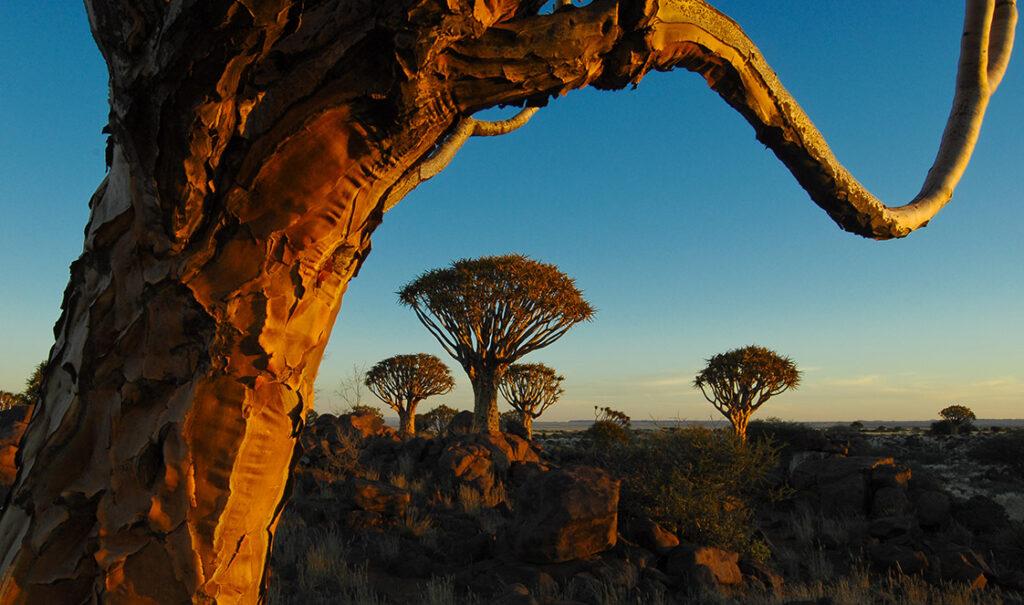
The Best of Namibia
Places Windhoek, Kalahari, Fish River Canyon, Luderitz, Tiras Mountains, Namib Desert, Swakopmund, Ugab Valley, Etosha National Park, Waterberg Plateau
from getting current exchange rate… per person sharing
Experience the canyon – from gorge walks to stromatolites
On the edge of the gorge, you can enjoy a picnic or read about the history of the gorge’s formation. You can also take leisurely walks to the various viewpoints. But don’t get too close to the edge, as there are no fences. But there are always stunning views of the canyon landscape. The viewpoint at Hiker’s Point is famous for the 550-million-year-old stromatolites on the floor next to the toilet (if they haven’t been trampled in the meantime, of course).
Stromatolites are carbonate metabolites from the calcareous excretions of algae and bacteria that formed dense carpets on the bottoms of shallow seas. They have existed for about 3,500 million years and are among the oldest forms of life on our planet. These small colonies of bacteria were responsible for the development of free oxygen in the oceans, which eventually filled the atmosphere. Stromatolites are therefore one of the most important foundations of evolution. Very exciting.

Another great option is to hike through the gorge over a distance of 80 to 90 kilometres. This can only be done in the cooler winter months and is best suited to the more adventurous. The trail from Hiker’s Point to Ai Ais takes four to six days, depending on your mood, and only has facilities such as toilets and campsites at the start and end. So you will have to bring and carry everything yourself, unless you hire porters. Along the way you will enjoy breathtaking views, wilderness and natural tranquillity. There are several hot springs in the gorge. These include ‘Sulphur Springs’ a few kilometres South of the main viewpoint or at Ai Ais, where you can find a spa. This spa also has a hotel where you can relax after your exploration.
Is the Fish River Canyon worth a visit? Conclusion
The Fish River Canyon is a specialty of Namibia, as it is the largest canyon in Africa. There is really no reason why the Fish River Canyon should not be worth visiting. Even its remoteness, which may be too remote for some, is a plus for those who like to travel off the beaten track. A visit is worthwhile for the following reasons:
- It is isolated from the usual tourist routes
- It is Africa’s largest gorge
- It offers excellent views of bare geological formations
- It is home to some of the oldest forms of life
- It amazes with magnificent views
- It offers beautiful walks and exciting hikes
- And it offers great accommodation in the area

If you are considering a trip to Namibia and a visit to the Fish River Canyon, please feel free to contact us. We are always happy to answer any questions you may have and to help you plan your trip to Namibia – whether it is a guided tour or a self-drive trip! Just get in touch!
Author: Juan Proll


