 on Tripadvisor


Namibia Wildlife
Namibia’s vast and varied landscapes are home to an extraordinary range of animals. Its rugged mountains, open savannahs and lush riverine wetlands each support unique ecosystems and wildlife, from desert-adapted mammals to migratory and endemic birds.
This Namibia animals list highlights the country’s remarkable species diversity. Whether tracking predators or observing graceful herbivores, a safari in Namibia’s national parks and private reserves promises unforgettable encounters in the wild.
WILDLIFE AND BIRDS – NAMIBIA SAFARI ANIMALS
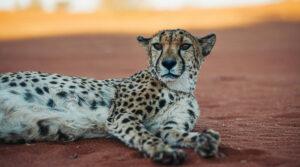
Cheetah
The cheetah is Africa’s fastest land animal and one of Namibia’s most iconic predators. With the world’s largest free-roaming population, Namibia is the ultimate destination to see these elegant cats.
Cheetahs are most commonly spotted in central Namibia’s farmlands and open savannahs, as well as private reserves, including:
- Waterberg Plateau Park – home to several cheetahs reintroduced through conservation programmes; on guided drives, you can observe them hunting or resting in the shade.
- Okonjima Nature Reserve – famous for the AfriCat Foundation, which monitors and rehabilitates cheetahs; you can join tracking safaris to see these cats up close.
Early-morning game drives or walking safaris offer the best chance to witness these noble predators with their distinctive tear marks.
Giraffe
Known for its towering height and distinctive patterns, the giraffe is one of the most recognisable and graceful Namibia animals. Widespread across savannahs, woodlands and semi-arid regions, these gentle browsers are a common sight throughout the country. One of the best places to observe them is
- Etosha National Park, where they often gather around waterholes. Early morning or late-afternoon game drives offer the best opportunities to watch them as they move across the open plains.
Using their long, prehensile tongues to navigate thorny branches, giraffes feed primarily on acacia leaves. Despite their size, they move with remarkable elegance and can reach impressive speeds when threatened.
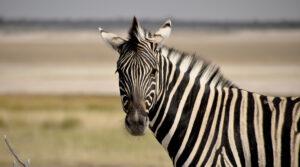
Zebra
Namibia is home to both the plains zebra and the mountain zebra, two distinct species adapted to different habitats.
- Plains zebras are most commonly spotted in Etosha National Park, where they gather in large herds across open grasslands.
- Mountain zebras, on the other hand, prefer rugged terrain and are typically found in areas such as the Naukluft Mountains.
Easily recognised by their black-and-white stripes – as unique as a fingerprint – zebras use these patterns for camouflage and social identification. They are highly social animals, often seen grazing together or moving in coordinated groups.
While it’s relatively easy to spot throughout the day, morning or late-afternoon game drives provide the best opportunity for encounters.
Antelope in Namibia
There is an impressive variety of Namibia antelope species, each uniquely adapted to the country’s diverse habitats. From arid deserts to lush wetlands, these animals play a vital role in the ecosystem and are a highlight of any safari.
Their differing sizes, behaviours and habitats make them fascinating to observe across the country’s national parks and reserves.
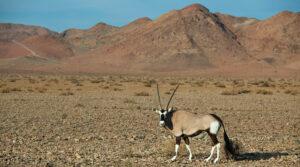
Oryx
The oryx, also known as gemsbok, is a symbol of resilience – and, alongside the fish eagle, a Namibia national animal. Perfectly adapted to life in arid regions like the Namib and Etosha, it can survive extreme temperatures and long periods without water.
Greater Kudu
Known for its impressive spiral horns, the greater kudu is one of the largest antelope species. Shy and elusive, they can be found in Etosha’s eastern and southern woodlands or in other bushy areas.
Sable & Roan Antelope
Both the sable antelope and the roan antelope are rarer sightings in Namibia. Admired for their curved horns, they prefer savannah and woodland habitats like the ones found in the Caprivi Strip.
Springbok
The springbok is one the most widespread Namibia antelope species, renowned for its energetic leaps, or “pronking.” It is commonly seen in open plains and desert regions, including Etosha National Park and Kaokoland.
Red Lechwe & Sitatunga
The red lechwe and the sitatunga are semi-aquatic antelope found in wetter regions such as the Caprivi Strip. While less frequently seen, they offer a unique contrast to more common Namibia wildlife that is adapted to desert life.
WHERE TO SEE THE BIG 5 IN NAMIBIA
Lion
Celebrated for their social prides and commanding presence, lions are amongst Namibia’s most iconic predators.
- Etosha National Park offers excellent opportunities to see these majestic cats, particularly around waterholes in the dry season.
- Lions are also occasionally spotted in Damaraland, where desert-adapted prides navigate rocky hills.
- In the Kalahari, open plains provide dramatic early morning sightings.
Guided game drives at dawn or dusk give the best chance to observe hunting, resting, or pride interactions. These predators are highly social, and sightings often reveal territorial displays, or cooperative hunting.
Given enough patience, you may witness the full strength and elegance of a pride in its natural habitat.
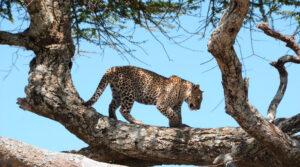
Leopard
Renowned for their stealth and striking rosette-patterned coats, leopards are among Namibia’s most elusive predators.
- Etosha National Park offers the best chance of sightings, particularly in woodlands and rocky outcrops.
- Waterberg Plateau Park provides opportunities to spot these solitary cats resting in trees or moving quietly at dusk.
- In Damaraland, leopards navigate rocky hills and riverbeds, making early morning or late-afternoon drives ideal for observing their movements.
Though shy by nature, leopards may occasionally be seen hunting or scavenging, offering a rare and unforgettable wildlife encounter. Guided drives and walking safaris provide the best chance to witness the full beauty of these remarkable predators.
Elephant
Celebrated for their intelligence, social behaviour and impressive size, elephants are among the most iconic Namibia wildlife species.
- Etosha National Park offers excellent opportunities to see these gentle giants, particularly around waterholes during the dry season.
- Elephants are also frequently spotted in Damaraland, where desert-adapted herds navigate rocky hills and dry riverbeds.
- In the Caprivi (Zambezi Region), riverine corridors and floodplains provide dramatic early-morning and late-afternoon sightings.
Elephant sightings often reveal strong family bonds and complex interactions, from protective matriarchs guiding calves to adults foraging for food. Their social behaviour is best observed during guided game drives at dawn or dusk.
Rhino
Namibia is home to both the black and white rhino. Throughout the country, there are concerted efforts in place to ensure their survival through conservation and anti-poaching initiatives.
- Etosha National Park is a stronghold for black rhinos, supported by ongoing conservation programmes.
- Damaraland is known for desert-adapted black rhinos, and guided tracking safaris provide safe opportunities to observe them.
- Favouring open savannahs and arid woodlands near water sources, white rhinos are rarer. They can occasionally be seen in private reserves such as Ongava Game Reserve and Okonjima Nature Reserve.
Guided drives and tracking excursions offer the best chance to witness this endangered species in Namibia.
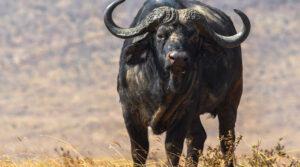
Buffalo
As they are drawn to water, buffalo are relatively rare in Namibia’s dry and arid landscapes. In general, they favour floodplains or areas near waterholes where they move in protective herds.
- Mahango Game Park offers some of the best opportunities to see these large, sturdy herbivores.
- Bwabwata National Park, Khaudum National Park, and Mudumu National Park provide sightings in woodland and riverine habitats.
- They can also be occasionally observed roaming parts of the Caprivi (Zambezi Region).
The best chance to observe their imposing horns, muscular build, and herd dynamics is during early-morning or late-afternoon outings. Sightings are less frequent than with other Big Five species, which makes encounters encountering particularly memorable.
ENDANGERED AND UNIQUE SPECIES IN NAMIBIA
Brown Hyena
Renowned for their shaggy coats and distinctive cream markings, brown hyenas are elusive predators. They are highly social yet secretive, living in clans that forage over vast areas. With populations sparse and widely dispersed, they are primarily found in north-western Namibia.
- Damaraland is home to desert-adapted brown hyenas, which roam rocky hills, dry riverbeds, and arid plains.
- Skeleton Coast National Park offers sightings along desert flats and coastal areas, particularly at dawn or dusk.
- Small groups can be found in Kaokoland, where their secretive behaviour and wide-ranging movements make encounters rare but highly rewarding.
Guided dawn, dusk, or night drives offer the best chance to witness their resourcefulness, hunting and scavenging strategies.
Pangolin
Pangolins are elusive, nocturnal mammals, recognised for their protective keratin scales and unique feeding habits, primarily consuming ants and termites. Favouring arid woodlands and rocky outcrops, they are occasionally found in
- the famous Etosha National Park,
- Damaraland,
- and parts of the Namib-Naukluft National Park.
Their secretive nature makes sightings extremely rare, but guided night drives and specialised tracking tours increase the chances of encounters.
Pangolins are a critically endangered species in Namibia – and globally –, making any encounter unique and exceptional.
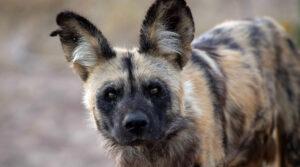
Wild Dog
Renowned for their striking coats and highly social hunting packs, African wild dogs are among Namibia’s most endangered predators. They are primarily found in
- Bwabwata National Park,
- Khaudum National Park, and the
- Mudumu National Park.
These remote, undisturbed areas allow packs to roam freely. Encounters are most likely on game drives and walking safaris, particularly early in the morning when they are most active.
Observing their cooperative hunting, playful interactions, and strong pack bonds provides a rare and unforgettable experience in Namibia’s northern wilderness.
Desert adapted Lion
Renowned for their exceptional resilience, desert-adapted lions survive in Namibia’s arid north-west, where water is scarce and prey is dispersed.
- Damaraland is home to small prides and solitary males that use rocky hills and dry riverbeds as cover for hunting.
- Kaokoland hosts prides that cover vast, arid landscapes, relying on stealth and endurance to hunt in extreme conditions.
- Palmwag Concession occasionally provides sightings, especially along waterholes or in areas frequented by desert-adapted elephants and other prey species.
Guided safaris offer the best chance of observing their lean physiques, remarkable stamina, and resilience in extreme environments.
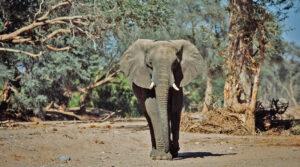
Desert adapted Elephant
Smaller than the typical African elephant, Namibia’s desert-adapted elephants are renowned for their ability to survive in arid, semi-desert environment
- Damaraland is a prime location to observe these highly intelligent and resilient animals, roaming dry riverbeds, and scattered savannahs.
- Kaokoland hosts herds that move across vast arid plains and seasonal river valleys, often travelling long distances in search of water and food.
- Palmwag Concession offers additional sightings in a semi-protected area where desert-adapted elephants are studied by conservationists.
Tracking and guided excursions provide the best chance to witness desert elephants in their natural habitat.
BIRDS OF NAMIBIA
With over 650 recorded species across diverse habitats, bird watching in Namibia offers world-class opportunities for casual and dedicated ornithologists.
The country’s rich avifauna includes raptors, waterbirds, songbirds, and endemic species. Throughout the year, they can be observed in national parks, private reserves, or along the coast.
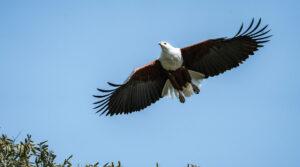
African Fish Eagle
The African Fish Eagle is instantly recognisable by its striking white head, dark body, and powerful call. Renowned as Namibia’s national bird, it is commonly found near rivers, lakes, and wetlands. Areas this majestic bird is frequently spotted in include
- Etosha National Park is a prime location to observe fish eagles around permanent waterholes and pans. Sightings are more common during the dry season when they hunt for fish and monitor other waterbirds.
- Caprivi (Zambezi Region) offers excellent sightings along river channels and floodplains, where eagles perch on trees or rocks, calling and swooping for fish.
Observations of this majestic bird in flight, perching, or calling across the landscape are highlights on any birding Namibia safari.
Pale Chanting Goshawk
The pale chanting goshawk is a medium-sized raptor with grey plumage, rufous thighs, and a distinctive melodic call. Feeding on insects, small mammals, and reptiles, it is a skilled hunter, often observed scanning from perches in open habitats.
- Etosha National Park is a common spot to see these elegant raptors perched on acacia trees or fence posts. Your best chances for sightings are early morning and late afternoon.
- Waterberg Plateau Park provides open savannah and rocky escarpments where hunting goshawks may swoop down to catch prey.
- Damaraland offers sightings in semi-arid scrublands, where the goshawk’s distinctive call often announces its presence.
Guided game drives and walking safaris increase the chance of spotting these graceful birds.
Southern Yellow-billed Hornbill
With its large curved bill and black-and-white plumage, the southern yellow-billed hornbill is a familiar and vocal presence across Namibia. As an opportunistic feeder, this bird consumes not only insects, but also fruits, seeds, and small reptiles.
– Etosha National Park offers excellent sightings in savannahs and woodland edges, where hornbills forage openly.
– Waterberg Plateau Park provides rocky escarpments and woodlands for observing their feeding and social interactions.
– Khaudum National Park allows encounters in dry woodland habitats, often in small family groups or pairs.
Their loud calls, acrobatic movements, and social behaviours make them easy to spot, providing engaging experiences for birdwatchers.
Crimson-breasted Shrike
The crimson-breasted shrike is a small, vividly coloured songbird, with a bright red breast, black mask, and grey wings. It is often perched conspicuously in dry savannah and woodland areas, scanning for insects and small prey.
- Etosha National Park provides excellent opportunities to witness their bold behaviour and distinctive call along savannah edges.
- Waterberg Plateau Park hosts these shrikes in wooded hills and scrublands, where their vibrant colours contrast with arid landscapes.
- Damaraland offers sightings in semi-arid areas, where they forage for insects, small reptiles, and berries.
With its bright plumage, this striking species is a favourite among birdwatchers. It is best observed during early mornings and late afternoon.
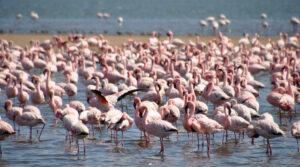
Lesser Flamingo
Unlikely though it may seem, flamingos are found throughout Namibia. They gather in large colonies, feeding on microscopic algae in saline and alkaline lakes.
As Namibia’s smallest flamingo species, the lesser flamingo is instantly recognisable by its pale pink plumage and black-tipped wings.
- Etosha Pan hosts spectacular flocks during the wet season, when shallow waters provide ideal feeding conditions.
- Walvis Bay Lagoon is an excellent coastal site for observing mass congregations and dramatic flights at sunrise and sunset.
- The Makgadikgadi Flats area occasionally sees transient flocks during seasonal migrations, offering rare viewing opportunities.
Early morning and late afternoon are the best times to observe these birds feeding, and displaying typical social behaviour. As they take off in synchronised flight, lesser flamingos are a highlight for photographers and bird enthusiasts alike.
DISCOVER EXCLUSIVE NAMIBIA SAFARIS



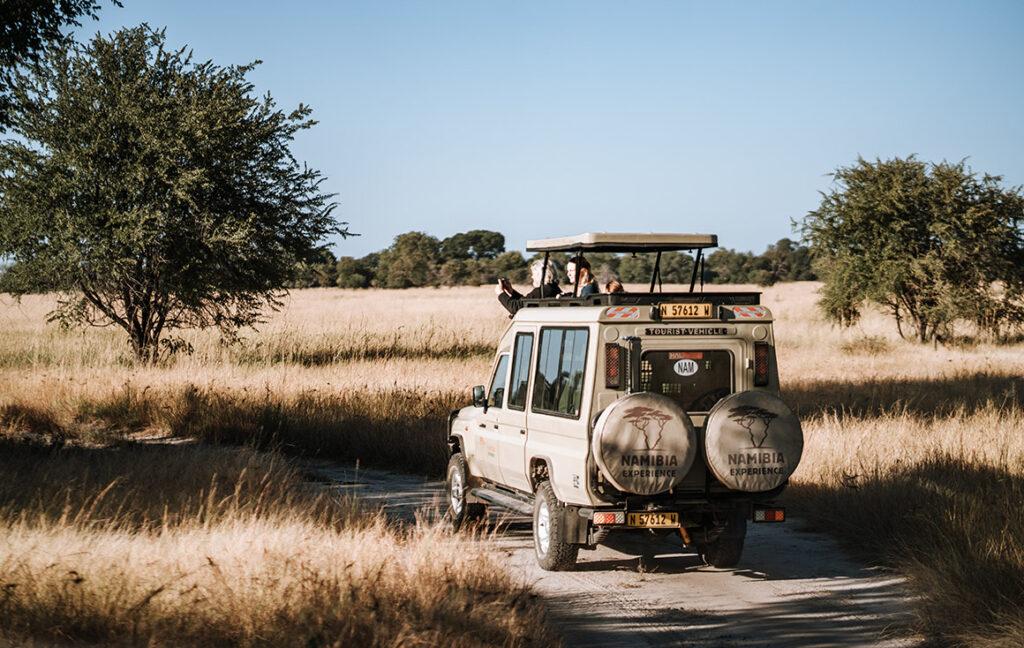

OUR EXPERT ADVICE
Focus on Quality Sightings, Not Quantity
In Namibia, wildlife viewing is more about meaningful moments than constant sightings. Slower days often lead to more rewarding encounters.
Our experts help you set the right expectations and pace to get the most out of every game drive.
Contact us for a no-obligation conversation.


Experience Namibia with us
Speak to one of our local advisors
x
Let's start planning your trip!
We will get back to you within 2 working days.