 on Tripadvisor




Sign up for our newsletter
"*" indicates required fields

Get to know the ins and outs of travelling Namibia
As a local tour operator, we are part of your journey from planning to organising and running your Namibia trip.
We have many years of experience in ensuring that you have a smooth trip and don’t need to worry about a thing. But you should keep a few things in mind before travelling to Namibia.
Here, we share our detailed expert travel advice for your Namibia trip.
The most popular travel time in Namibia is the dry season between June and October. These months are also the best time to visit Etosha National Park. If wildlife viewing is not at the top of your list, travelling in the low season can have advantages. We share advice on the best time to travel depending on different regions and seasons.

Windhoek is the starting point for most trips around Namibia. But which visa do you need to get here and how do you get to your next destination? Find out whether a self-drive trip, guided tour, or fly-in package is the best option for you.
Find out which factors determine the price of your trip, which currency to use in Namibia, and how much you should budget for tipping. It’s always better to now before you go!
From road safety to malaria risk and things to consider when on safari. While Namibia is considered a safe and low-risk malaria travel destination, we share expert travel advice on how to stay safe on its lonely gravel roads and beyond.
Just don’t pack too much! We could end our packing list here, but if you want to know a few more details on what to bring to Namibia and in which type of bag to put it all, study our packing list and travel packing advice.
Namibia is home to extraordinary wildlife, found in national parks, private reserves, and remote wilderness areas. From sweeping deserts and dramatic dunes to rocky mountains and seasonal riverbeds, each region supports its own unique mix of species.
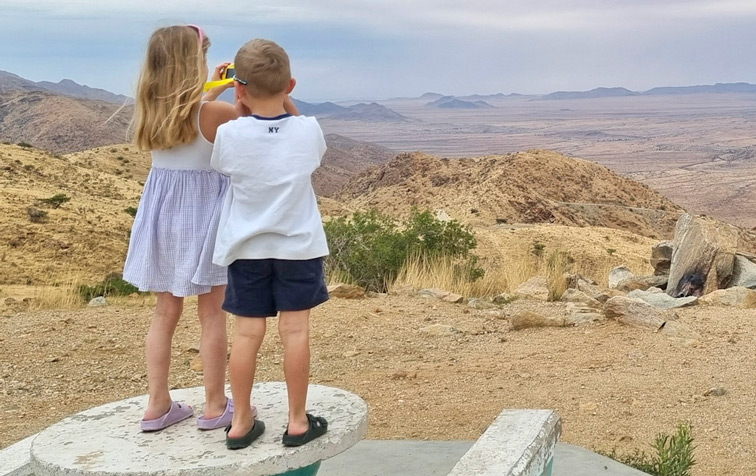
If planned carefully, travelling to Namibia with children will be an unforgettable family adventure. With its vast landscapes, empty spaces, and unique wildlife, the country offers a sense of freedom rarely found elsewhere.
824,292 km² (318,261 sq mi)
ca. 2.23 Million
Windhoek
Swakopmund
English is the official language of Namibia; but other frequently spoken languages include Oshiwambo, Khoekhoegowab, Afrikaans, RuKwangali and Otjiherero.
Namibia Dollar (NAD), South African Rand (ZAR)
+264
The majority of the population identifies as Christian, while around 10% identify with Islam, Buddhism, or traditional beliefs.
Dry season: May – October (winter, cooler temperatures)
Green season: November – April (summer, hot temperatures)
Namibia generally has a warm and dry climate, and it doesn’t rain much.
During the hot summer months, especially January and February, temperatures can climb up to 33°C and even 40°C (91°F to 104°F).
Temperatures along the coast, are cooler and you can experience cold, foggy mornings. Nighttime in the desert can get rather cold as well.
The main international airport for arrivals and departures is Hosea Kutako International Airport (WDH, HKIA).
Domestic airports are serviced by private charter planes, and there are hardly any domestic scheduled flights.
A comparably large number of nationalities do not need a visa to enter Namibia for tourist purposes. Please consult the Namibian embassy or consulate in your home country for visa advice before your travels.
We will contact you by phone or email within 24 hours during business hours.
You are currently viewing a placeholder content from Instagram. To access the actual content, click the button below. Please note that doing so will share data with third-party providers.
More InformationYou are currently viewing a placeholder content from reCAPTCHA. To access the actual content, click the button below. Please note that doing so will share data with third-party providers.
More Information